Laterite is a red, iron-rich rock formed by thousands of years of tropical rain, soft enough to be cut when freshly quarried and hardening into durable stone once it meets the air. It shaped the traditional homes, churches and compound walls of Goa, and it remains one of the most considered materials a residence here can carry.
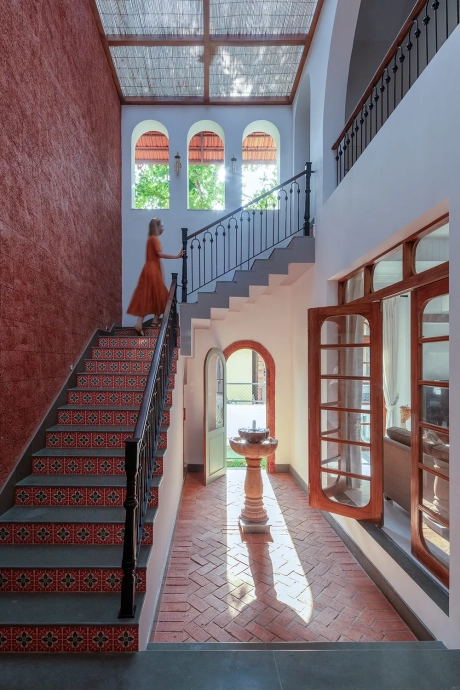
If you are weighing a second home in Goa, understanding laterite explains why the older houses feel the way they do. Vianaar uses hand-cut laterite in its Goa villas, from the staircase at Villa Cardo to the garden steps at Villa Mandarina, and a later section lists where the stone appears.
Laterite at a Glance
- What it is: a weathered, iron- and aluminium-rich rock that forms in hot, wet climates.
- Colour: red to red-brown, from iron oxide minerals such as goethite and hematite.
- Hardness: roughly 2 to 4 on the Mohs scale, rising as the stone cures in the air.
- Origin of the name: coined in 1807 by Francis Buchanan-Hamilton from the Latin later, meaning brick or tile.
- Where it is found: the Western Ghats of India, Southeast Asia, West Africa, northern Australia and the Amazon Basin.
- Local names: Vianaar's writing calls Goan laterite Patradevi, and its post "Let's Talk Patradevi" adds Chira as the local name.
- Typical use in Goa: walls of houses, churches, forts and compound walls, traditionally finished in lime plaster.
How Laterite Forms
Laterite is the product of very long, very wet weathering. In tropical and subtropical regions, high rainfall and heat break down almost any parent rock. Percolating water dissolves and carries away easily soluble elements such as sodium, potassium, calcium, magnesium and silicon, leaving behind the insoluble iron and aluminium.
That residue is laterite. Its red-brown colour comes from iron oxide minerals, chiefly goethite and hematite, while its aluminium content is held mainly in gibbsite, a hydrated aluminium oxide. Where the aluminium content is high enough, the same material becomes bauxite. The process needs an iron-bearing parent rock, well-drained ground, abundant moisture and a great deal of time, on the order of thousands of years.
Why It Is Cut Soft and Cures Hard
Freshly quarried laterite is relatively soft and can be cut into blocks with simple tools. Once exposed to sun and air it hardens, and this change is irreversible. It is the reason laterite has been quarried and shaped by hand for centuries, from Goan stone yards to the temples of Angkor Wat in Cambodia, which were made with laterite blocks.
Properties of Laterite Stone
Laterite varies from quarry to quarry. Strength, density and porosity shift with the depth at which the stone is cut, and deeper, more compact stone is generally stronger. A 2024 study in Discover Materials by Bhat and colleagues tested four laterite varieties from the Udupi region of Karnataka, in the same south-west Indian laterite belt, and gives a useful picture of the range:
|
|
|
|
|
|
|
|
|
|
|
|
|
|
|
All four varieties stayed within that absorption limit. Two of the four met the paper's requirements for load-bearing masonry, and the strongest variety also performed best in moist conditions. The weakest two were judged suitable for non-structural work only.
The practical lesson is that the grade of the stone matters as much as the decision to use laterite, and that stone should be tested for compressive strength and water absorption before it is specified. These figures come from Karnataka samples, so they describe the range to expect, and a Goan quarry will have its own numbers.
Laterite in Goa: A Long Tradition
Laterite has been Goa's most common traditional walling stone, cut into brick-like blocks and used for centuries in homes, forts, temples and churches. During the Portuguese period it was used for grand churches and administrative structures, usually finished with lime plaster to resist weathering.
The architecture that grew around it was shaped by the climate. In the words of one account of Goan houses, protection from the fierce monsoon was the basis of architectural form. Walls were first made of mud and later of laterite, usually plastered and painted. From the mid-18th century, Catholic homes added balcões, covered porches with built-in seating open to the street, where families caught the evening air. For the wider design history, see Vianaar's reading on art and architecture in India and its guide to Indo-Portuguese architecture.
Laterite in Vianaar Homes
Vianaar's design writing describes laterite as native to Goa and says the studio uses hand-cut laterite stones for both aesthetic and practical reasons. Across its completed Goa homes, the stone appears as a visible, tactile element, placed where the eye and the hand meet it:
|
|
|
|
|
|
|
|
|
|
|
|
|
|
|
|
|
|
|
|
|
|
|
|
Each of these homes pairs the stone with other materials that Vianaar's pages name, among them handmade terrazzo, Black Basalt, Mangalore-tiled roofs and teakwood. The result is a residence that reads as modern in its planning and Goan in its materials. Vianaar's guide to Goa villa design sets out how these choices sit alongside courtyards, verandahs, rainwater harvesting and native planting.
Why Vianaar Chooses Patradevi
Vianaar's post Let's Talk Patradevi sets out the studio's reasoning in five points. These are Vianaar's own statements and carry no test data:
- Humidity. Vianaar describes the stone as offering immense durability in areas of high humidity, and says its porous nature has long made it a traditional Goan material.
- Temperature. Vianaar says the stone has good insulation properties that help regulate indoor temperature.
- Local sourcing. Because the stone can be sourced locally, Vianaar says it conserves energy and reduces transportation costs.
- Exterior cladding. Vianaar says the stone is mainly used as exterior cladding, which it says helps avoid excessive mining, and that leftover material is laid as pathways around the properties.
- Colour and character. The earthy brown of the stone sits against the green of creepers and plants on each house, which Vianaar says adds charm and character.
The post ties these choices to slow living in Goa, and says materials are chosen for practicality and function as well as aesthetics.
Why Laterite Suits Goa's Climate
Goa's climate asks a lot of a wall. Weather records for Dabolim show annual rainfall of about 2,925 mm, with 2,630 mm of it falling between June and September, which is roughly 90 percent of the year's rain in four months. July alone brings about 995 mm. In the pre-monsoon months of March to May, daytime highs reach 35 to 36 degrees Celsius.
Laterite answers both extremes in ways that are widely described. No measured thermal figures for Goan laterite turned up in the sources reviewed, so these points are the accepted explanation and carry no tested number:
- Thermal mass. Thick laterite walls absorb heat slowly through the day and release it slowly at night, which moderates the temperature indoors. Vianaar's design notes make the same point, describing laterite walls as natural insulation that keeps interiors cool in Goa's warm months.
- Breathability. The stone is porous, so water vapour can move through a laterite wall, which helps in months of very high humidity.
- Local material. Stone cut near the site avoids long transport and has been described as carrying far lower embodied energy than fired brick or concrete block, although the sources reviewed give no figures. Vianaar makes the same case for local sourcing, saying it conserves energy and reduces transportation costs.
The same porosity that lets laterite breathe is also its weakness. Unprotected laterite absorbs water, and in heavy rain it can weather, or grow algae and moss.
Caring for Laterite Through the Monsoon
Specifiers and conservators generally recommend a few habits for laterite:
- Use lime plaster or another breathable plaster on walls that are left covered. Avoid dense cement plaster and film-forming paints, which can trap moisture inside the stone.
- Use a breathable stone sealer on exposed laterite such as steps, stairs and pillars, and reapply it periodically.
- Cap compound walls with coping stones and keep plinths off standing water with a damp-proof course.
- Choose the stone carefully and test it, since quarry, depth and density change how a surface behaves.
- Let monsoon water drain and soak away. Vianaar's Villa Mandarina lists grass pavers and rainwater harvesting pits among its sustainability features, and Vianaar's design writing notes that grass pavers let rainwater percolate naturally.
For an owner who spends the rains elsewhere, the routine matters as much as the material. Vianaar's listings for Villa Cardo, Villa Mandarina and Villa Da Fiore name property management and housekeeping among their care services.
Conclusion: A Stone Worth Living With
Laterite records its own origins in its colour, hardens only after it is cut, and has shaped Goan homes for centuries because it answers the climate honestly. If you are considering a home here, ask what the stone is, where it was quarried and how it has been protected. Those answers say more about a house than any brochure.
To see how Vianaar places laterite in a residence, and to ask about current homes, get in touch with Vianaar.